
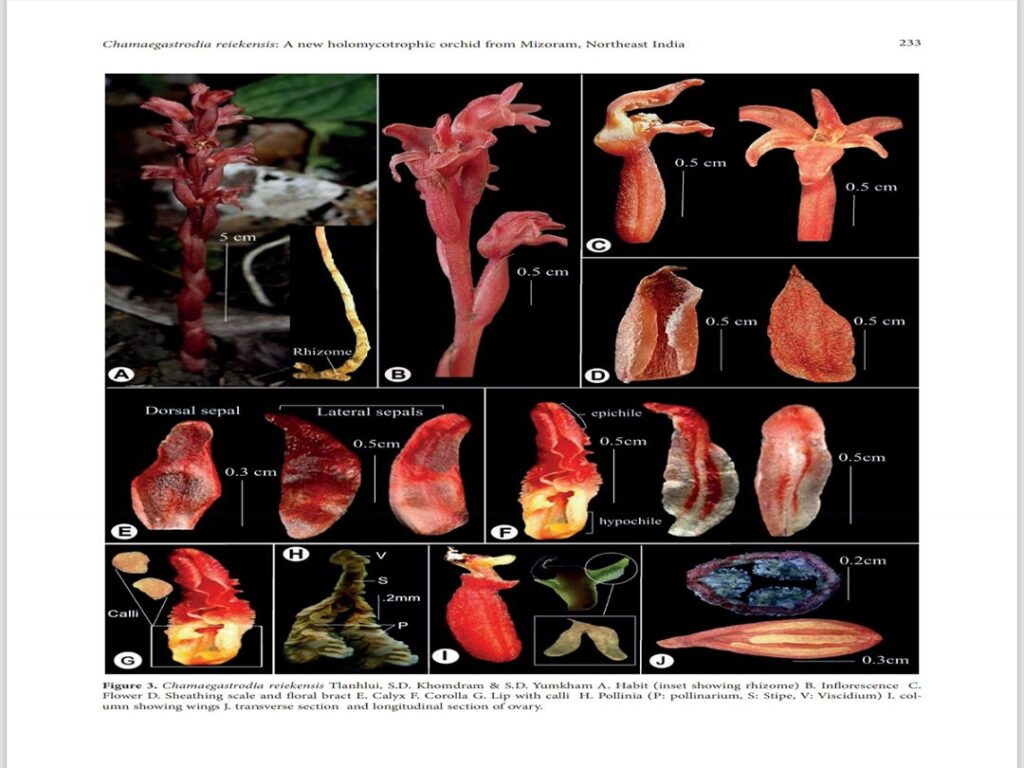
In a remarkable advancement for botanical science, researchers from Mizoram University and Manipur University have discovered a new and extremely rare orchid species, Chamaegastrodia reiekensis, in the mountainous region of Reiek, Mizoram. This newly identified species, named after its type locality, highlights the unique biodiversity of Northeast India.
Belonging to the enigmatic genus Chamaegastrodia, C. reiekensis is holomycotrophic—lacking chlorophyll and leaves, and entirely dependent on subterranean fungi for its nutrition. Incapable of photosynthesis, this orchid’s existence is intricately tied to its fungal associations, making it exceptionally rare and vulnerable.
With this discovery, the global count of known Chamaegastrodia species rises to eight, with all Indian representatives found exclusively in Northeast India. These elusive orchids are sparsely distributed across select regions in Asia, underscoring the region’s underexplored but rich biodiversity.
Chamaegastrodia reiekensis has been provisionally assessed as Critically Endangered (CR) under IUCN criteria. Its inconspicuous nature—lacking green foliage and emerging only briefly for flowering—makes it challenging to detect and particularly susceptible to environmental threats.
“This discovery is significant not only for its scientific value but also as a reminder of the fragility of such ecosystems,” remarked Dr. Khomdram Sandhyarani Devi, Department of Botany, Mizoram University, one of the lead researchers. “Its complete reliance on subterranean fungi makes Chamaegastrodia reiekensis exceptionally vulnerable. The fact that it has been assessed as ‘Critically Endangered’ at the time of its discovery is a sobering reminder of the mounting threats faced by these unique habitats.”
The study, published by Ms. Laltlanhlui, Research Scholar in the Department of Botany, Mizoram University, underscores the urgent need to conserve both this rare orchid and the delicate ecological networks upon which it depends.
Read more: Webbia Journal Article